Are stuffed animals safe for newborns and babies? (What age is OK?)


Are stuffed animals safe for newborns and babies? (What age is OK?)

Someone just gifted your newborn the world's softest teddy bear, and now you're googling at 1 a.m. wondering if it's allowed anywhere near the crib. Deep breath — here's the honest, no-hedging answer, from a plushie company that would love to sell you ten bears but would rather tell you the truth first.
Quick answer: Stuffed animals should stay out of a baby's sleep space for the entire first 12 months — the American Academy of Pediatrics recommends nothing soft in the crib to reduce suffocation and SIDS risk. Before age 1, plushies are safe only as supervised playtime props and nursery decor. From 12 months, a small, well-made plushie can join the crib, and ages 1–3 are when a "lovey" attachment naturally forms. Goodlifebean's baby-friendly picks start at $19.99 and use embroidered (not plastic) details.
The age-by-age rules, in one table
| Age | In the crib / sleep space? | Outside the crib? |
|---|---|---|
| 0–12 months | No — nothing soft in the sleep space (AAP safe-sleep guidance) | Yes, supervised only: tummy-time visual interest, photos, shelf decor |
| 12–24 months | Yes — one small (under ~30cm / 12in), well-constructed plushie | Yes — this is prime lovey-bonding age |
| 2–3 years | Yes | Yes — expect a full plushie entourage and strong opinions |
| 3+ years | Yes, any size | Yes — giant plushies become genuinely usable and adored |
What to Look for in a Baby Stuffed Animal

Safety First:
- No small parts: Embroidered eyes/noses (no buttons or beads).
- Non-toxic materials: Phthalate-free stuffing and dyes.
- Machine-washable: Easy cleanup after messy playdates.
Developmental Perks:
- Textured surfaces: Crinkly ears, ribbed fabrics, or soft faux fur for tactile exploration.
- Interactive features: Gentle sounds, rattles, or teething-friendly accessories.
- Lightweight design: Easy for tiny hands to grip and cuddle.
Why nothing soft before 12 months (the part we won't sugarcoat)

The American Academy of Pediatrics' safe-sleep recommendations are unambiguous: for the first year, a baby's sleep surface should be firm, flat, and bare — no pillows, no blankets, no bumpers, and no stuffed animals. Soft objects can cover a baby's face or create pockets of rebreathed air, and babies under 12 months can't reliably move away. It doesn't matter how breathable, organic, or expensive the plushie is; the safest number of stuffed animals in a crib before age 1 is zero.
We know that's not the answer a gift-giver wants. It's still the answer. (Bookmark the AAP's safe sleep guidance at healthychildren.org — it's the source your pediatrician uses.)
What newborn plushies ARE for: the nursery shelf, the monthly milestone photo, supervised floor play where a high-contrast face gives tummy time a focal point, and — honestly — the parents. More than one exhausted new mom has told us the Chubby Highland Cow on the glider was her 3 a.m. feeding companion. A plushie bought at birth isn't wasted; it's waiting.
What changes at 12 months

Around the first birthday, the suffocation risk profile changes: babies can roll, reposition, and move objects away from their faces, and the AAP's bare-crib window ends. This is also exactly when developmental psychology gets interesting — toddlers begin choosing a "transitional object," the one comfort item that stands in for you when you leave the room. Pediatricians widely consider this healthy: a lovey helps toddlers self-soothe at bedtime, at daycare drop-off, and through every disruption from travel to new siblings.
Translation: the plushie gifted at the baby shower gets its job at the first birthday. If you're gifting for a newborn, you're really gifting for the one-year-old they'll shortly be — which is a better gift anyway, because that's the plushie they may keep for twenty years.
The 6-point safety checklist before you buy (any brand, including ours)

- Embroidered eyes and details, not plastic parts. Buttons, beads, and glued-on noses are choking hazards once little fingers get strong. Every baby-appropriate Goodlifebean pick below uses stitched or embroidered features.
- Sturdy, double-stitched seams. Toddlers stress-test seams daily. Tug the limbs and ears hard in every direction; nothing should give. (If a loved plushie does eventually split, here's how to repair a torn plushie safely — always re-check seams before returning it to a toddler.)
- No ribbons, cords, or loose accessories longer than a few centimeters — strangulation and choking risks both.
- Machine-washable or easily spot-cleaned. A lovey gets chewed, dragged, and adored. Wash monthly, more during illness — our plushie cleaning guide covers the gentle-cycle method.
- Right-sized: smaller than the child, bigger than a choking hazard. For 1–2 year olds, roughly 15–30cm / 6–12in is the sweet spot — huggable but never engulfing. Save the giants for age 3+.
- Quality fill that won't clump or leak. We stuff with 100% premium PP cotton — resilient, hypoallergenic-grade, and it survives both the washing machine and the toddler years. Cheap pellet-filled plushies are a leak risk; skip them for babies entirely.
Baby-safe picks from our shelf (honest sizing included)

| Plushie | Size | Why it works for littles | Price |
|---|---|---|---|
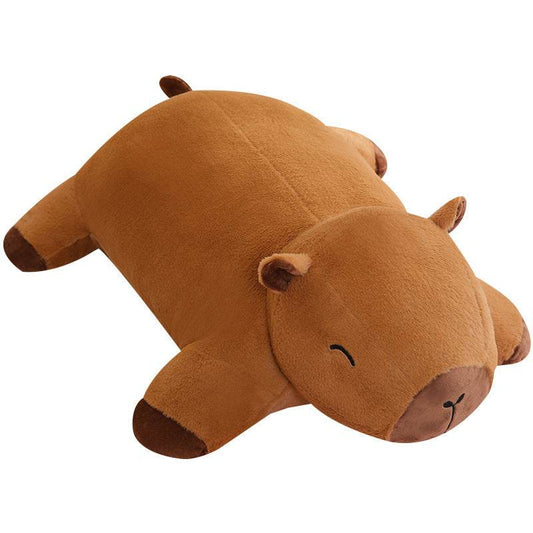
| Cappy the Capybara | Compact | Soft-sculpted face, embroidered details, lightest in the lineup | $19.99 |
| Cute Mini Highland Cow | 25cm / 10in | Perfect lovey size at 12 months+, fur invites little fingers | $34.99 |
| Bumbee the Bee | Lap-size | Round, no protruding parts, built to be squeezed | $25.00 |
| Pookie Mini Panda | 45cm / 18in | The "first big plushie" for 2–3 year olds | $40.00 |
| Giant Life Sized Teddy Bear | 70cm+ / 28in+ | The 3rd-birthday showstopper — decor until then | from $74.99 |
Everything ships free to 30+ countries, insured, in 10–17 business days — order 3 weeks ahead of the shower or birthday to be safe, and first orders get 15% off with code CUDDLE15. Browse the full Mini Plushies collection for more lovey-sized options.
A note for gift-givers (the card matters)
If you're gifting a plushie to a family with a newborn, add one line to the card: "For the nursery shelf now — for snuggles after the first birthday." You'll instantly signal that you know the safe-sleep rules, the parents won't have to awkwardly relocate your gift, and the plushie gets a proper debut later. Gift-giving with the safety note included is the power move.
FAQs
Can my newborn sleep with a stuffed animal?
No. The AAP recommends nothing soft in a baby's sleep space for the entire first 12 months — no stuffed animals, pillows, blankets, or bumpers. Keep plushies to supervised awake time and nursery decor until the first birthday.
What age can a baby have a stuffed animal in the crib?
From 12 months, one small, well-made plushie (roughly 15–30cm / 6–12in, embroidered features, no loose parts) is generally considered fine. If your baby was premature or has health considerations, confirm timing with your pediatrician.
Are stuffed animals good for babies during the day?
Yes, with supervision. Plushies give tummy time a focal point, become characters in early play, and later anchor the healthy "transitional object" attachment toddlers use to self-soothe.
How often should I wash my baby's stuffed animal?
Monthly as a baseline, weekly if it travels or gets mouthed constantly, and immediately after illness. Use a gentle cycle in a laundry bag and air dry fully — damp fill can grow mildew inside.
What materials are safest in a stuffed animal for a baby?
Look for tightly-woven soft plush outers, 100% PP cotton or similar resilient fill, embroidered (never plastic) eyes and noses, and no ribbons or cords. Goodlifebean plushies use embroidered details and PP cotton fill throughout.
Is a giant teddy bear safe for a toddler?
Wait until about age 3. Before that, a plushie larger than the child is an awkward (and in a sleep space, unsafe) companion. From 3+, giant teddy bears become the beloved room anchor — many families buy at birth and let it live as decor until then.
The bottom line
Stuffed animals and babies are a wonderful pair — just on a schedule: shelf and supervised play in year one, first small lovey at 12 months, the full soft menagerie after that. When you're ready to pick the plushie that'll be waiting at the first birthday, start with our Mini Plushies collection →